Patrick Boylan: the kid who hated piano lessons now builds the app to fix them
Patrick Boylan used to get grounded for skipping piano practice. Now he plays piano bars around LA and runs MuseFlow, an app that makes learning to read music feel like a game.
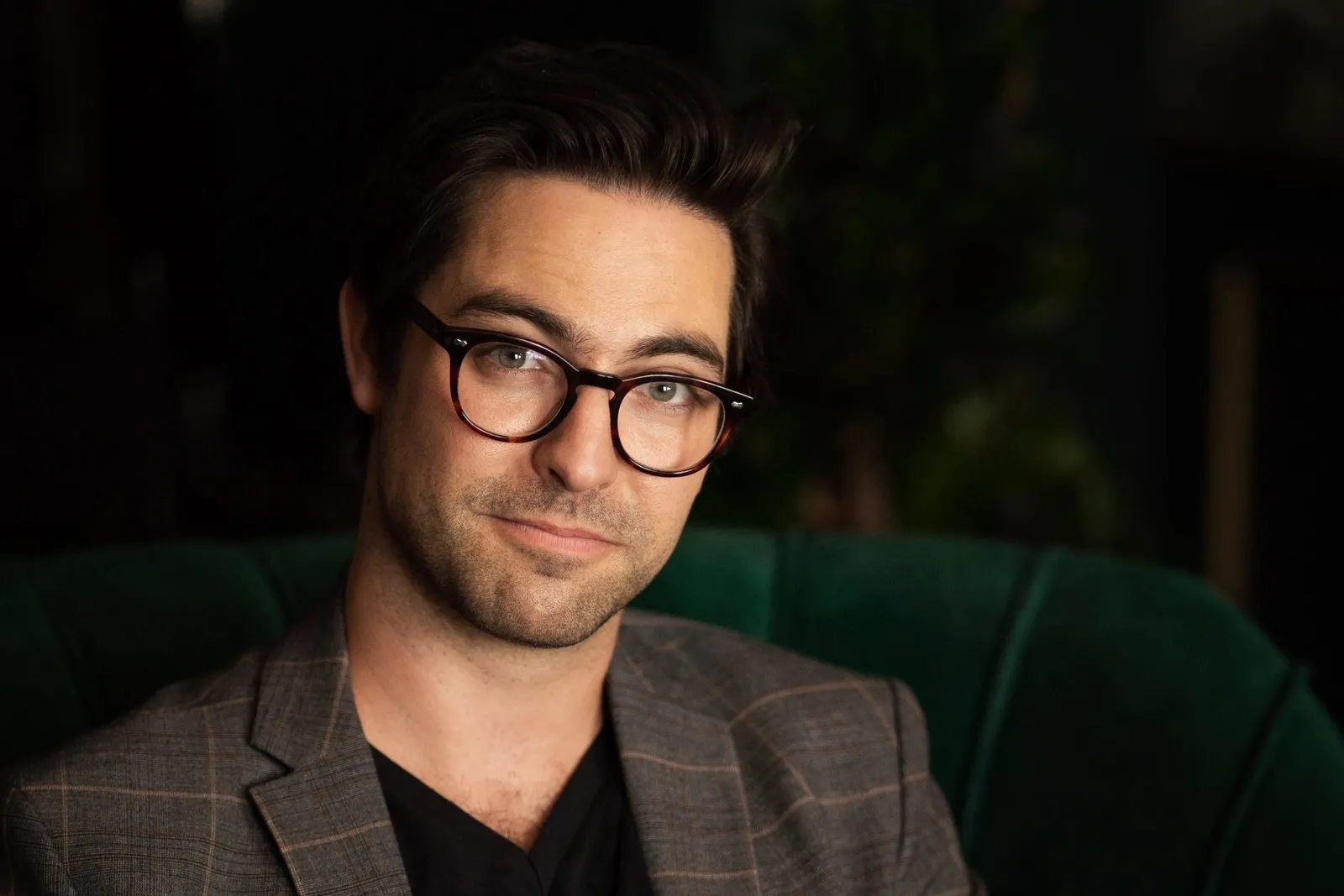
Patrick Boylan is a Los Angeles pianist, multi-instrumentalist, and actor, and the co-founder and CEO of MuseFlow, a game-based music education app built around sight-reading and flow state. As a kid, he hated traditional piano lessons until his teacher retired and he started pulling short phrases from his parents’ musical theater songbooks and improvising on them for hours. Years later, after moving to LA to act, he took his wife Weslie’s advice to try gigging on piano full-time, learned the top 400 piano bar songs, became a regular performer at spots like Tramp Stamp Granny’s, and eventually turned his self-taught practice method into a music startup.
I especially wanted to talk to Patrick because of his versatility between music, acting, theater, and founding a startup. As I head into college and try to take what I’ve learned in music toward the music industry, I was curious how he connects all of them. What I most wanted to know was how someone who hated piano lessons as a kid ended up playing piano for a living, and then built an app to make learning music feel less like a chore.
Your parents grounded you if you skipped piano practice as a kid. Looking back, what about those lessons didn’t click for you, and what kept you going?
If I tried to quit piano, my parents would ground me. If I didn’t practice, they would ground me. What really didn’t click was that I have ADHD, and traditional piano lessons are built around practicing the exact same songs over and over until they’re “perfect.”
Perfection kills creativity. And in traditional piano lessons, perfection is the name of the game. For someone whose brain is wired to explore, tinker, and chase new patterns, sitting on a bench repeating the same sixteen bars for weeks felt like torture. I remember sitting on the piano bench at nine years old, crying because I wasn’t allowed to go outside and play with my friends until my thirty minutes were up.
What kept me going at first was pretty simple: I didn’t want to get grounded. My mom is a phenomenal singer, and I think secretly she wanted a built-in piano accompanist in the house. Years later, I thanked my parents by what I call the transitive property. I don’t thank them directly for forcing me through lessons I hated, because that part was rough, yet if they hadn’t kept me at the instrument long enough to know where the notes were, I never would have discovered my own way into music when my teacher retired.
When your teacher retired, you started pulling phrases from your parents’ sheet music and improvising around them. What was that like, and when did you notice it was working?
After eight years of lessons, my teacher finally retired, and I was free. No more recital pieces, no more gold stars, no more scales I didn’t care about. My parents were big musical theater fans and had shelves of vocal scores around the house, including Stephen Sondheim’s Sunday in the Park with George.
I pulled that book off the shelf, opened it up, and found one short musical motif that caught my ear. I couldn’t play the whole score as written, because Sondheim’s piano reductions are notoriously dense, so I just took that one phrase and started playing with it. I repeated it, inverted it, flipped what my right hand and left hand were doing, shifted it from 4/4 into 3/4, swung the rhythm, and transposed it into different keys. All of a sudden, two hours had gone by and I hadn’t looked at the clock once. I was completely in flow.
I didn’t realize what that practice had actually built until I got to college. I was an acting major, and I happened to be the only acting major in my class who played piano. All my musical theater friends started handing me sheet music for their auditions and cabarets, asking, “Hey Pat, can you play this for me?” I’d put the binder on the stand and just read it down on the spot. That was the moment it clicked: all those hours of pulling apart small phrases and improvising around them had quietly taught me how to sight-read and speak the language of music in real time.
You can sight-read almost any musical theater score, and you love Sondheim. How did musical theater become your thing, and which Sondheim show deserves more love?
Musical theater was in my house from day one because of my parents, and once I became an actor, I fell in love with how great theater music serves the dramatic moment. Most composers write songs that are plot-driven or hook-driven. Sondheim writes music that is completely character-driven. Every rhythmic hiccup, every harmonic shift, every inner voice in the accompaniment is an extension of a character’s psychology and subtext. That’s why he always preferred hiring actors who could sing rather than singers who could act.
From a piano standpoint, Sondheim’s scores are orchestral reductions that jump all over the keyboard with constant key changes, odd meters, and contrapuntal inner lines. Once you cut your teeth on Sondheim, sight-reading almost anything else in pop, rock, or musical theater feels easy by comparison.
As for which show deserves more love, it has to be Sunday in the Park with George. Act One is a masterpiece about the obsession and isolation of making art, and songs like “Finishing the Hat” and “Move On” mean everything to me as a creator. There’s a lyric in “Move On” where Dot tells George: “Stop worrying if your vision is new / Let others make that decision, they usually do. You keep moving on.” Anytime you’re building something from scratch, whether it’s a song, an acting career, or a startup, that line is gospel.
You acted in LA for years before Weslie asked why you weren’t playing piano for a living. What was it like to turn the thing closest to your heart into your job?
I actually have a confession to make here: acting, not piano, is the thing closest to my heart. Piano is my first love, and I play it every day, yet acting was always my biggest love and the reason I moved to Los Angeles in the first place.
For years, while I was grinding away at auditions and survival jobs in LA, people would hear me play and ask why I didn’t gig on piano for a living. I always told them, “Oh, piano is too close to my heart, I don’t want to ruin it by turning it into a job.” Looking back, that was really an excuse because I had never trained the way concert or jazz conservatory pianists trained, and part of me was afraid of being exposed as an impostor.
Then my wife Weslie called my bluff. She looked at me one day and said, “Why don’t you actually try playing piano for a living? You love doing it, and people light up every time you sit at a keyboard.” So I gave myself a challenge. I sat down, learned the top 400 piano bar songs, started booking gigs around LA, and within three months I was making my full living playing piano. And instead of ruining piano for me, gigging made me fall in love with it all over again because it connected my playing to a live room full of people.
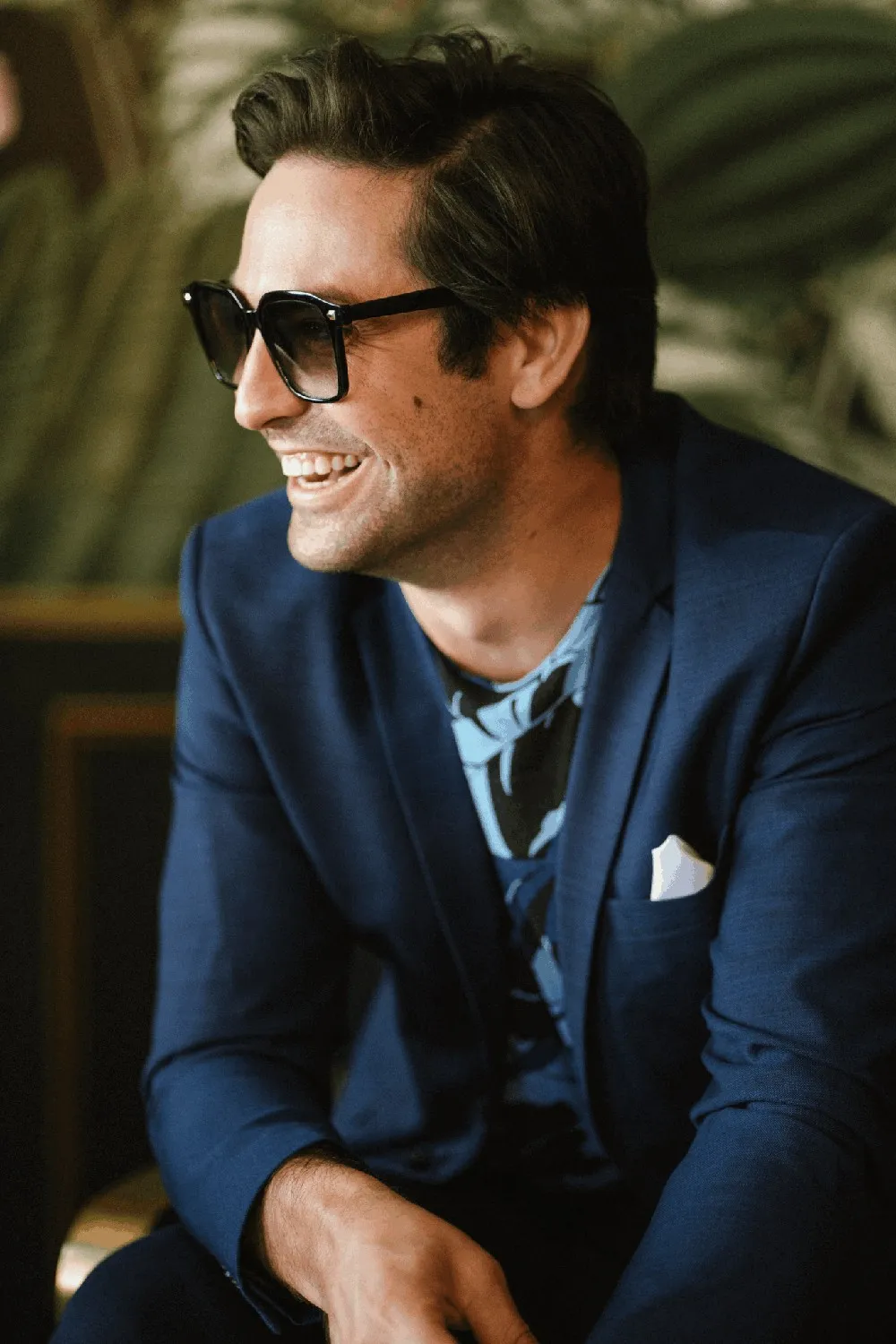
What’s a typical night at a piano bar like Tramp Stamp Granny’s? What do you do when someone requests a song you’ve never played?
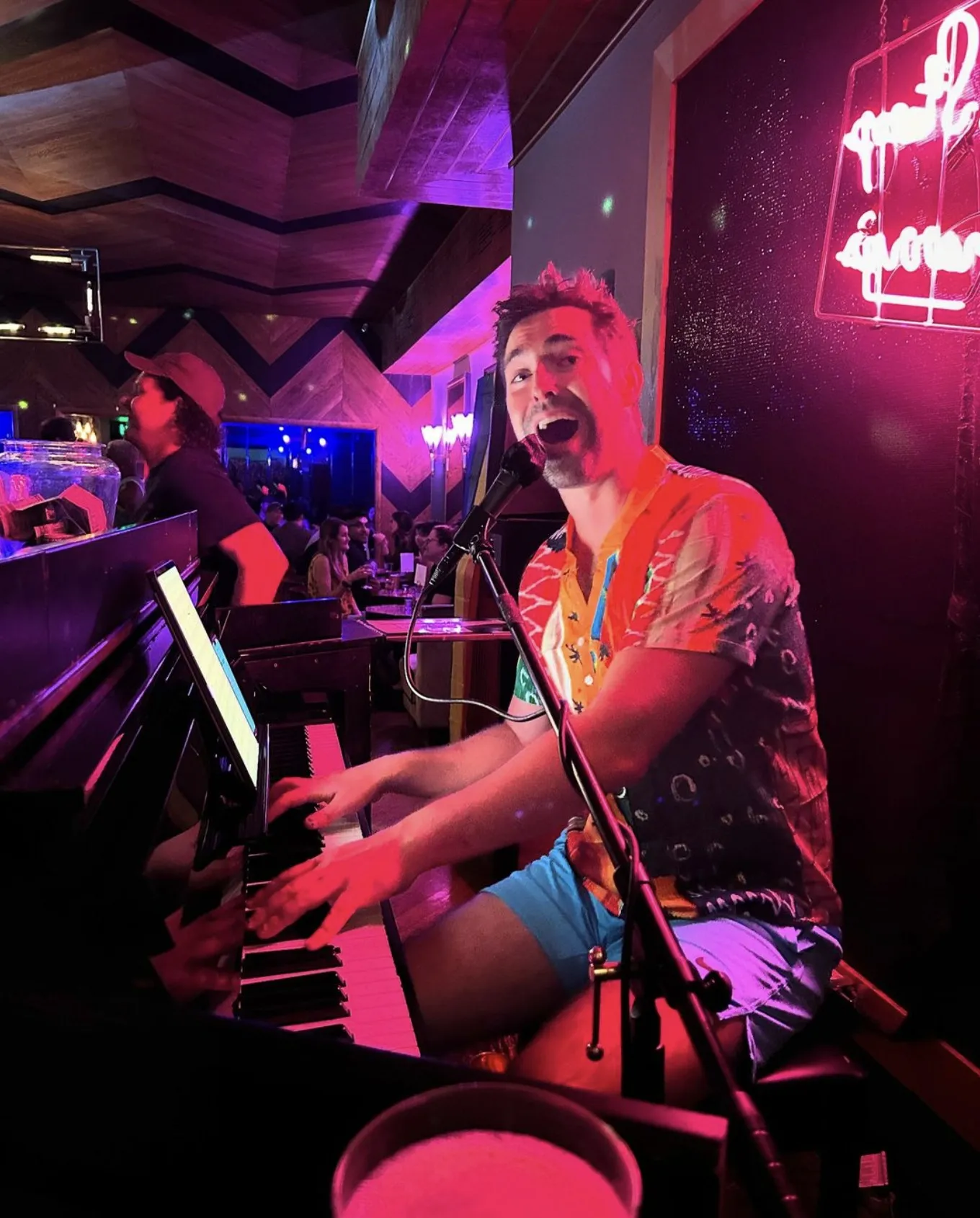
Tramp Stamp Granny’s is iconic, a vintage Hollywood cocktail lounge owned by Darren Criss and his wife Mia, where the whole room sings along at the top of their lungs. On a typical night, I’ll grab dinner next door around 7:00 PM, walk in around 7:30 to do a quick soundcheck with the bartender (who also runs the soundboard), and then play either the 8:00 to 11:00 PM shift or the 11:00 PM to 2:00 AM late shift, three hours nonstop with no setlist.
Early on, I noticed that paper request slips and shouting over the crowd slowed everything down, so I taught myself enough HTML and JavaScript to code a dark-mode web app hosted on GitHub. I put QR codes on all the tables around the bar. When you scan the code on your phone, you can search my full songbook by title, artist, decade, or genre. When you tap a song, it deep-links straight into Venmo with a $5 tip pre-filled and the song title already in the note.
If someone searches for a song that isn’t in my list, a button pops up that says, “Have Pat learn that song.” When they click it, it sends an automated email straight to my inbox that basically says: “Somebody at Tramp Stamp Granny’s requested this song that you don’t know, shame, learn it.”
In the middle of a set, though, if someone tips well for a song I’ve never played before, I’ll pull up the chords or sheet music on my iPad, listen to ten seconds of the track in one ear if I need the groove, and sight-read it live. And if it’s a song where I only know the chorus, I’ll play the intro, turn the mic to the room, and let a hundred people in the bar sing the verses for me. At a piano bar, energy and commitment beat note-for-note perfection every single time.
What other instruments do you play, and did you teach yourself those too? A lot of drummers learn by ear. How would the MuseFlow approach carry over to drums, where reading is mostly rhythm?
Besides piano, my main instrument is voice. In college, I studied with a wonderful voice professor named John Koch, who was a big bass-baritone. I walked into his studio thinking I was a musical theater tenor because all the leads are tenors, and he listened to me for two minutes and said, “Pat, you’re a baritone. Stop strangling your throat and sing with your actual body.” In middle school I played clarinet, and in high school marching band my best friend and I were both 6’2“, so the band director handed us Sousaphones. Later on, for different acting and theater gigs, I taught myself acoustic guitar, cajon, upright bass, and mandolin using the exact same motif-and-flow approach I used on piano.
Drums are actually something we think about a lot for MuseFlow’s future. Because drum notation is rhythmic rather than melodic, the visual mapping is even more direct than piano. A lot of drummers have great ears and hands, yet they freeze up when someone puts a chart in front of them.
When we expand MuseFlow to drums, we won’t build it by guessing from a piano bench. We’ll bring in a dedicated drumming pedagogist to design the skill tree from the ground up, combining real-time rhythmic sight-reading on an electronic kit or practice pad with ear training and groove variations. Whether a drummer wants to be a hobbyist jamming to songs in their garage or a session player reading big-band charts on the first take, the engine works the same way: isolate one rhythmic vocabulary piece at a time and feed you constantly new patterns at the edge of your ability so you stay in flow.
MuseFlow gets called the “Duolingo of music education.” How did your own experience at the piano turn into an app, and what was the hardest part of building it?
I like to pitch MuseFlow as “Duolingo plus Guitar Hero for piano, except it actually teaches you how to play piano.”
When I looked back at how I taught myself to play, I realized the secret wasn’t that I was improvising; the secret was that I was keeping my brain in a flow state by playing music that was just challenging enough and never repeating the exact same phrase twice. Improvising is hard to grade with software, whereas sight-reading newly generated music that targets one micro-skill at a time gives you the exact same cognitive workout and is completely measurable through MIDI.
I brought the concept to my friend and co-founder Steven Gizzi, who is a composer and music educator, and together we mapped out how an adaptive music generation engine could adjust tempo and complexity in real time to keep a student in what we call the “Goldilocks Zone,” never too bored and never too frustrated.
The hardest part of building it was translating a musical feeling into code for engineers. In the early days, one of our developers had never touched a piano keyboard in his life. Explaining why traditional apps feel “high-touch” and interruptive, with constant menus, pop-ups, and restarts, while MuseFlow needed to feel “low-touch” and continuous, didn’t click in slide decks. So I ended up building two interactive prototypes: one high-touch version where you had to click through screens after every exercise, and one low-touch version where the music just kept flowing and adapting seamlessly as you played. The second our team sat down and played both back-to-back, everybody in the room felt the difference immediately.
Players advance at 95% accuracy over four phrases of music that never repeats. Why those numbers, and do you worry learners miss out on polishing one piece until it’s theirs?
That 95% threshold is deliberate, and it comes straight from neuroscience and from gigging in the real world. When you force a student to hit 100% accuracy before they can move on, their nervous system tightens up. Chasing that last 5% is where anxiety kicks in and flow dies. At 95% accuracy across four consecutive phrases at our baseline tempo of 72 BPM, your brain has proved that it understands the pattern and can execute it reliably in time, while leaving room to be human.
Think about live performance. When I’m playing a three-hour set at Tramp Stamp Granny’s, or when you’re playing drums with a band on stage, the audience has no idea if you missed 5% of the notes on the page. The only two things that matter in live music are: did you convey the musical ideas, and did you emotionally move the audience?
At the same time, we know people love having songs they can polish and play for their friends. That’s why MuseFlow has two sides: the Sight-Reading Trainer, where music never repeats and 95% keeps you moving through the curriculum, and the Repertoire Library, where you unlock real songs matched to the exact skills you just mastered. Inside the Repertoire Library, if you want to nail a tricky measure at 100%, we built a tool called the Perfect Phrase Counter that lets you select a specific phrase and loop it until you hit it clean 2-4 times in a row… you decide how many you want. Sight-reading builds the fluency first, so polishing a repertoire piece takes minutes instead of days.
On The T.R.O.N. Podcast, you talked about martial arts alongside music. How do martial arts and music practice overlap for you?
The overlap between martial arts and music is huge for me. In martial arts, you have two main modes of training: kata (forms) and sparring. When you practice kata, you’re working through movements solo, focusing on balance, breath, and muscle memory so the technique becomes second nature. That’s what solo flow-state practice is on an instrument.
Then you step onto the mat to spar with a live partner who isn’t following a script. In sparring, if you stop to think about what your feet are supposed to do, you get hit. Your training has to live in your nervous system so you can read and react in the moment. Sight-reading and gigging in front of a live crowd are musical sparring. You prepare your vocabulary in flow, and then when the count-off starts, you let go of perfection and respond to whatever the room throws at you.
As I head into college, I’m pivoting from being a drummer to the business side of music. You’ve made big pivots yourself, from acting to piano to MuseFlow. What’s your advice for navigating a change like that?
Whenever you pivot into a new field, attack it from two directions at once: bottom-up and top-down.
Bottom-up means getting your hands dirty and doing the actual work day in and day out before you feel ready. When I pivoted to gigging on piano, bottom-up meant sitting down and learning those 400 piano bar songs and playing every room in town. When I pivoted into running a tech startup, bottom-up meant taking online Udemy courses on Agile project management and teaching myself Figma over a weekend so I could mock up product screens myself instead of being a bottleneck for our designer.
Top-down means studying the big picture from people who have already mapped the territory: your college professors, books, mentors, and industry leaders. One of my favorite pieces of business advice is simple: follow the money, see where value is actually being created and exchanged, and ask why. Another rule I live by is: if it’s easy, keep going, then find the top. We’re taught to believe that everything worthwhile has to feel like a miserable grind, like me crying on the piano bench at age nine. Often, the thing that comes naturally to you, the thing where two hours fly by in twenty minutes, is your biggest unfair advantage. Follow that thread, push it until it gets hard, and then bring in top-down mentorship to take it to the highest level.
Never stop learning. Never stop being hungry for new ideas, new skills, and new rooms where you’re the beginner again.
Try MuseFlow at museflow.ai, find Patrick Boylan at thepatrickboylan.com, and follow him on Instagram at @pboylan_official and MuseFlow at @museflow.ai.