Ashleigh Watson on Huntress, retro soul, and finding your people
Ashleigh Watson is a retro soul singer and songwriter from Melbourne who joined her first band at 14 and spent more than a decade getting her debut album, Huntress, made. We talked about touring young, working with producer Michael Cristiano, juggling a day job, staying safe as a woman on stage, and why she thinks PR is the first thing an independent artist should sort out.

Ashleigh is based in Melbourne, Australia. She joined a band called the Sweethearts when she was 14, and with them she sang lead at the Porretta Soul Festival and the Montreux Jazz Festival while she was still a teenager. Her debut album, Huntress, came out recently. She made it with Michael Cristiano, who produced it and co-wrote it with her, and it mixes soul, jazz, R&B and pop.
I wanted to talk to Ashleigh because almost every guest so far has been a player, and I wanted to hear from a singer who writes her own songs and runs her own career without a label. She’s also really honest about the parts that are hard: the day job, the people who don’t have your back, and what it’s like to be a woman on stage.
You’ve said you wanted to be a singer since you were about six. What pulled you toward music, and when did you realize it could be a career?
I would say I always knew that I wanted to be a singer just because I knew I was going to be a singer. It wasn’t something I thought I chose. Maybe you could say it chose me. I just always knew I was going to do it.
And I guess when you’re a kid you see pop stars that you admire, and for me it’s always been Kylie Minogue. And you go, well, that’s a job I can do. She’s doing it. So that’s what I’m going to do. So I kind of just always knew. But I think it wasn’t until I was about 14 and I joined my first band that I really understood the reality of making it a career, and wanting to make it a career.
You joined the Sweethearts at 14 and went on to sing lead at Porretta Soul Festival and Montreux Jazz Festival. What was that like at that age, and what did it teach you?
It was the best experience I’ve had to date in gigs, I would say, so far. It taught me what it’s like to tour with a group, and what it takes to be the best performer for the whole band and not just for you, even when you’re tired and jet lagged.
By the same token, we had the best time, all of us together, and they’re memories you could never recreate doing anything else. I guess it gave us a taste of what it’s like to be admired by an audience, as we had a little bit of a following over there at the time. And that was fun.
Huntress was more than a decade in the making. What were the biggest setbacks, and what kept you going?
For me the setbacks were really just finding a producer to assist me. And unfortunately some of the setbacks were also being involved with people who didn’t have my best interests at heart, and probably just were not quality people in the industry. I really had to pivot, and that’s when I had a chat to Michael Cristiano, who I was already colleagues with at the time, and he offered to help me.
That’s why it took so long. And not just that, I’d written some of these songs and hadn’t had the idea to necessarily put them in an album the entire time. When that idea came to me, then it was the challenge of finding a producer that was quality enough to work with, and that in itself was its own issue. These songs were just kind of in my back pocket. I hadn’t really thought of putting them into an album to begin with.
What was it like working with Michael, and how did that partnership shape the sound of the album?
Michael and I had the best time working together, because we’re already friends of nearly a decade. We work together on other jobs. We have a very close bond and we understand each other very well. He knows what I mean, I know what he means, we’re on the same page. And when you click like that with your producer, it brings a certain magic to the end product, because you gelled so well in creating it.
Michael’s the kind of producer that loves to be involved, and that’s why he didn’t just produce the album, he actually co-wrote it. So it really was a collaborative project from start to finish. And having someone who is so experienced in the industry meant my album was able to have that extra sparkle to it, because I was working with somebody who knew what they were doing. It came out and scrubbed up like a really professional finished product.
You’ve described Huntress as retro soul with “a bit of a magical, mystical vibe.” Where does that come from, and which song means the most to you?
The magical, mystical vibe is just me. It’s the other part of my personality, if you will. I am just quite a whimsical, earthy kind of chick, so the album having a hint of magic or mysticism behind it is not unusual for me. And it’s probably something that’s going to occur if I ever release anything in the future, which I definitely hope to.
They all mean something really significant to me, because they’re all about different relationships, or different aspects of a relationship, over the years. So they’re all very personal. But if I had to select just one, I think I would select “I Remember You.” That was not written about my own experience but the experience of someone very close to me, who lost a loved one very, very young and never got to live out what that relationship probably should have ended up being. I know that it’s extremely touching for that person that I’ve written that song for them. It’s very personal and significant to them, so that means a lot to me, to have been able to do that for them.
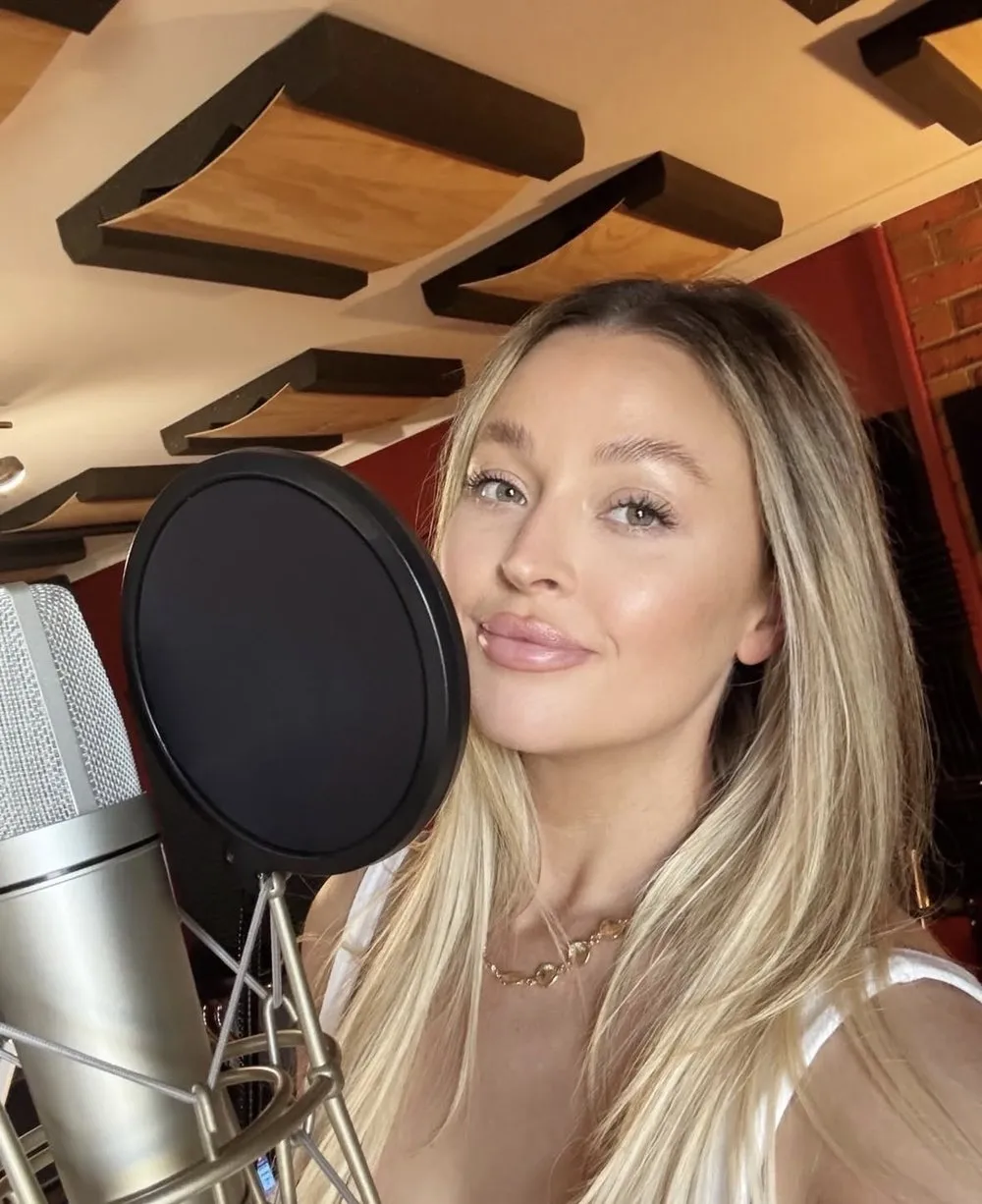
What does your songwriting process look like? Do you usually start with a melody, a lyric, or a feeling?
Being that I’m a singer first and foremost, it’s definitely lyrics for me. I actually don’t play any instruments. I have taken piano lessons along the way, but when I was a kid I was doing singing, dancing, acting, a little bit of modeling, theater as well, trying to do the whole thing. I did not have time to also learn an instrument. It’s something I’d like to do, but it’s not really necessary for my songwriting, because nowadays you’ve got great programs like GarageBand. So that’s actually what I use, GarageBand on my Mac.
Usually it’ll come from an experience that I’ve had. I’ll think of a really catchy hook, like a sentence or something to describe how I’m feeling, and a way to put that into a rhyme to make it catchy, and then I just expand from there. So generally I start with a hook that ends up being a chorus, and then I flesh out what I actually want to say in the verses. Then I start to put together the melody and whatever instruments I can hear. Usually I know what the beat should sound like, so I can put the drums into GarageBand, and a bass line, and usually keys.
Things like guitar or strings are a little more difficult for me to come up with ideas for. So again, that’s why working with Michael is so fantastic, because I didn’t have to fill in all those gaps myself and have them come out subpar. I could leave those gaps open and take whatever I had, whether it was 80% of the song or only the chorus, to Michael, and he would help me flesh out the rest with a fresh set of ears. That’s the beauty of a collaborative partnership.
As an independent artist, what does a normal week look like? How do you juggle gigs, other jobs, promotion, and writing?
With great difficulty! I’m extremely busy. As most other artists know, you generally have to have a day job, and I have had many. I’ve been a waitress, I’ve been working in retail or customer service of some kind since I was 19. Currently I’d say I have the best day job I’ve ever had, because I work on reception at a music lesson school. So I’m around music, and I’m also a super organized person, so reception was always something I actually wanted to try out. I enjoy it.
But that does mean very long days. I’ll get up and try to do normal person things like go to the gym and do groceries, and then during the day I’m songwriting, or replying to emails, or doing interviews, or trying to get some photos together for social media to advertise my album, whatever it may be. Then I’m off to work, and I work in the afternoon until eight o’clock at night. Then I come home, and after dinner I’m often responding to another email, or checking to see if I’ve been successful in getting an interview, following up the PR if you will, or working with my publicist on whatever I’ve got them doing for me.
So it’s a lot to juggle. But that’s the reality of being an independent artist. It’s wonderful to be able to put some of the work onto a publicist so you’re not doing it all yourself, but realistically, if you don’t have a manager, there’s still a lot you’re going to end up doing yourself. So it’s really important to have a good team around you that you can delegate stuff out to.
What has your experience been like as a woman in the music industry, and what would you like to see change?
Unfortunately it can be unsafe at times, and I have experienced those types of scenarios myself. Like I was saying before, it’s really important to have a good team around you, and that also includes people who are accompanying you to jobs, whether it be session work at someone’s studio that you don’t know, or going to a gig. I’m very grateful to have Michael on board, because with his expertise he’s able to give me sound advice and act as a buffer for a lot of my future connections.
Especially when you’re a woman, there can be people in the industry making promises they don’t intend to keep, or can’t keep. So you have to be really discerning about who’s actually able to help you, because nine out of ten people who offer to help you can’t.
I think it’s really important as well to make your band aware, to have situational awareness. As a female, or anybody, but particularly as a female, you can feel pretty vulnerable on stage or once you get off stage. So you have to be very, very careful to keep yourself safe.
Retro soul is starting to make a comeback. How do you keep a vintage sound feeling fresh, and how do influences like Amy Winehouse and Etta James show up in your music?
Well, funnily enough, when I first started wanting to sing, quote unquote, vintage or old-fashioned music, so many people told me it’s old, it’s been done, people aren’t going to want to listen to it. But I don’t know, maybe energetically I knew better, because I knew there would be a path paved for my music when the time was right. And literally, as I started getting a little older and singing this Motown music and jazz, and then recording my own and gigging it, people like Bruno Mars and Amy Winehouse were popping out of the woodwork. And I’m like, I told you. Everything old is new again.
I think when you’re confident in what you put forward, people will like it. You will always find your market, because there’s billions and billions of different types of personalities and likes and dislikes in the world. You’ll always find your niche.
And frankly, I was doing what I was doing at the same time as Amy Winehouse. So I wouldn’t say she’s someone I strived to be like. I was already like that. However, she most certainly paved the way, to let me know that I can do this, because people like this music. There is a market for it. And she did have some influence for sure, and primarily what that was for me was the honesty of her modern lyrics.
That sort of answers your question about keeping a vintage sound fresh, too. Lyrics are a really big one, because you’re going to speak differently now than the lyrics used to sound in the actual fifties, in the actual forties. You can get away with far more, and I think that’s a big tell in a song as to when it was actually written. And also the production: having a fresh way to record the song, with some sort of pop elements, is the key to freshening something up so it’s not, quote unquote, boring to audiences today.
In terms of older artists, Etta James and James Brown really liberated me, in feeling like I can be a female powerhouse. I can just let go and scream out a ballad and be a real soul diva if I want to, and there’s a market for that. My music’s an amalgamation of many different genres and artists that I like, but there’s a certain freedom there that allows me to have that sassy, sexy, powerful female identity on stage.
Last one. What advice would you give emerging artists who are trying to get their music heard without a label?
100%, PR. Make sure you have a good PR team. That is difficult to find, because a lot of PR is so expensive, and filled with people who want to be artists who don’t actually know what they’re doing. Do your research with prior clients of theirs, to make sure they actually got their clients radio play, streams, gigs, whatever it may be. Make sure there was actual evidence of their work.
I’m really fortunate to be working with a PR company called Fine Tuned PR, because Elena, whose company it is, knows what she’s doing. She knows the behind-the-scenes ins and outs of what’s required to actually get your song heard on platforms such as Spotify, which are important in the digital age. Because frankly, you could write a great song, but if you don’t have the right PR team behind you, it won’t get heard, and it’ll just be a total waste of time. So that would be my number one advice.
Her song “Take Me To The Water” is taking off on Spotify right now. Start there.
Ashleigh is represented by Fine Tuned PR, run by Elena. You can find Ashleigh at ashleighwatsonmusic.com and on Instagram at @ashleighwatsonmusic.