Harry Van der Meer on quads, bass, and the path without a time limit
For four years Harry Van der Meer was marching quads with the Blue Devils and studying bass at Berklee at the same time, flying back and forth between the two. Drum corps ends at 21. Bass doesn't. We talked about what that balancing act cost him, aging out, and what he's building now with his band Sophie's Body.
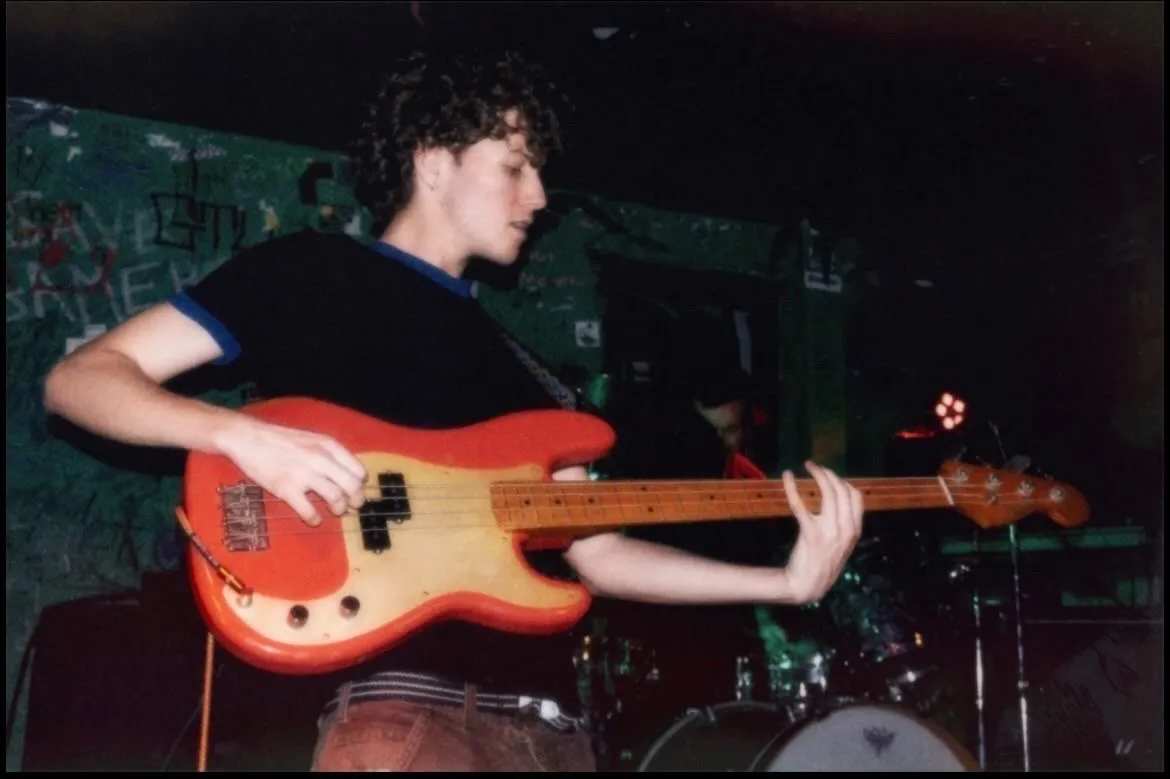
Harry Van der Meer is 22, from Northern California, and lives in Boston now. He plays bass and he’s a marching percussionist, and for the last four years he was seriously doing both at the same time, flying between Berklee College of Music and drum corps tour and trying to get really good at two instruments that have almost nothing to do with each other.
He’s aged out of drum corps now and graduated from Berklee. He plays bass in a rock band called Sophie’s Body, who have a debut album on the way and are getting ready to move to New York. I wanted to ask him what doing both actually looked like, what it cost him, and why he ended up putting everything into the one that doesn’t stop at 21.
Full disclosure, Harry and I know each other from the drum corps world, so this one is a little more like two friends talking.
Let’s start at the beginning. How did you get into music?
My family background is my mom and dad are gymnasts. They own their own small business and teach gymnastics. They had a former student who went off to Berklee College of Music in Boston, and he came back to Petaluma and started teaching lessons. And I was at the facility where my mom and dad were teaching, and they needed me to do something while they were working all the time. So they ended up putting me in private lessons so I’d do something other than twiddle my thumbs, if that makes sense.
That’s probably around age seven. I was just taking private lessons weekly or biweekly for quite a long time. I started on piano, and I didn’t stop, but I thought it was cool, I wasn’t super in love with it yet. Eventually I hopped around some different instruments and found my way to bass, and I was a little more into that. I started learning a song or two. And I vividly remember being in the car one day and asking my mom, like, hey, music lessons with Brian are really cool, can I do more music lessons with Brian? This teacher’s name is Brian Dolan, by the way. Very, very special man. Very influential to me. And she was like, yeah, okay, sure, that’s fine.
That kind of got the ball rolling. For maybe a year or two I was just developing skills with no real reason for it. I didn’t really care. But eventually I got more involved and joined my middle school jazz band, which went really well.
How did you end up on percussion, then?
This is where it kind of made a turn. I wanted to do jazz band in high school, but the rule was you can’t do it unless you do concert band, and I didn’t want to do that. So I said no. And then my middle school band director was like, hey, I think you’d really like it, you should change your mind, I’m going to send an email to the guy. I’m like, okay.
So I show up with nothing ready or planned, and the guy’s like, oh cool, welcome, what instrument do you want to play? And then somebody, she was actually my brother’s girlfriend at the time, dragged me to the percussion closet and was like, you’re gonna do percussion. I’m like, alright, sure.
From there the rest is kind of history. I just had a natural touch with the drums. Part of it is Brian had taught me a little bit of drum set. But when it came to marching percussion I think I just had a knack for it. Obviously I worked my butt off and practiced my ass off too. But it wasn’t even like I wanted to grind and be the best and achieve my dreams. It was more like I just couldn’t drop those drumsticks. You could ask anybody from high school and they’d be like, dude, if you’re looking for him, he’s probably drumming. And it’d be true. I’d be in the practice room.
How did Berklee happen?
When stuff started to get a little more serious, COVID happened. I was still drumming and doing my thing and posting on Instagram, but I was still playing bass in jazz band and such. And it got to a point where future plans had to be questioned and thought about. I wasn’t necessarily done with bass and other kinds of music.
I took a chance because my buddy Kody auditioned for Berklee and got in. He didn’t end up going, he’s at USC, he just graduated. But it inspired me to take college a little more seriously, because up to then all I cared about was drums, right? I was like, I don’t give a shit.
So I made B Corps in December of 2021, and then I think in February I took a last-minute shot at Berklee, just for the hell of it, because I wasn’t really thinking about anywhere else. It went pretty well and I got a pretty decent scholarship, and I was like, alright, let’s do it.
So the past four years I’ve been balancing being a marching percussionist and a drummer while also aspiring to be a high-level bass player. Flying back and forth between Boston and Laramie, Wyoming, and doing the tour and everything. Dude, it’s been a crazy four years, to be honest.
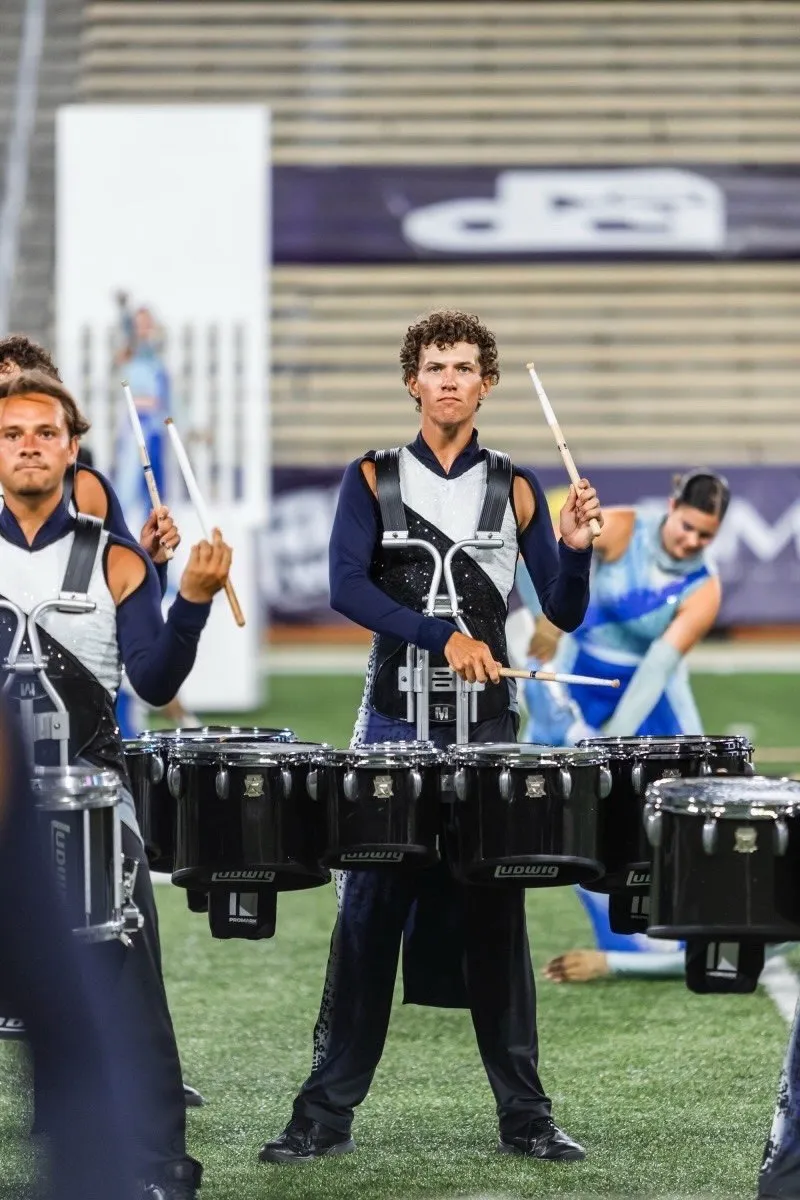
Those are basically two full-time jobs. How did you manage it?
Honestly, it’s something I’m actually just kind of getting over the hill with. I feel like now I can actually look back on it, because I’m aged out. I’m not eligible for another indoor season, I don’t think, and obviously I’m not going to do it.
And I kind of want to say that I wasn’t really managing it. It just kind of sucked. I’m not trying to say I was miserable over the past four years. But I’d be lying if I said there wasn’t a feeling of sacrifice for the marching arts, because I’m really invested in the bass stuff and really trying to work on my future, something that’s really gonna last, you know what I mean?
I think that was another really big reason I wanted to stick around with bass. And it’s the same thing my parents were really trying to push for. Like, hey, this marching stuff is amazing, and you clearly got a good touch for it. But realistically, what does that career path look like? And it looks like teaching. There’s nothing wrong with that. In fact there’s everything right with that, teaching is amazing. But for me it didn’t rub me the right way. It’s putting this idea in your head that you peak at 21 and you’re out of the game and you’re washed. And that’s not how that works. Or at least, it works that way for drum corps, but that’s not life.
Was it hard watching friends keep marching?
I can’t tell you how many times I’d be here in February, grinding my ass off for school, and it’s dumb cold, like 11 degrees, and I’m looking at my phone at my best friends. Eddie Morales, that guy’s like my brother. We got contracted together and spent the last three summers together at Devs. I remember when he decided to go and made RCC for 2025, I was just like, bruh. You know what I mean? Like, dude, I probably could’ve taken a shot at that line. I thought about all those possibilities, being around those people. Because the tough part is you can’t do it again once you’re done.
The saving grace was that I was building and sustaining and preparing for a future with bass here. With a band, and friends, and other music that’s gonna provide me with the same amount of love and fulfillment, but, what’s the word, it doesn’t have a time limit. It’s sustainable in that sense, as a performer.
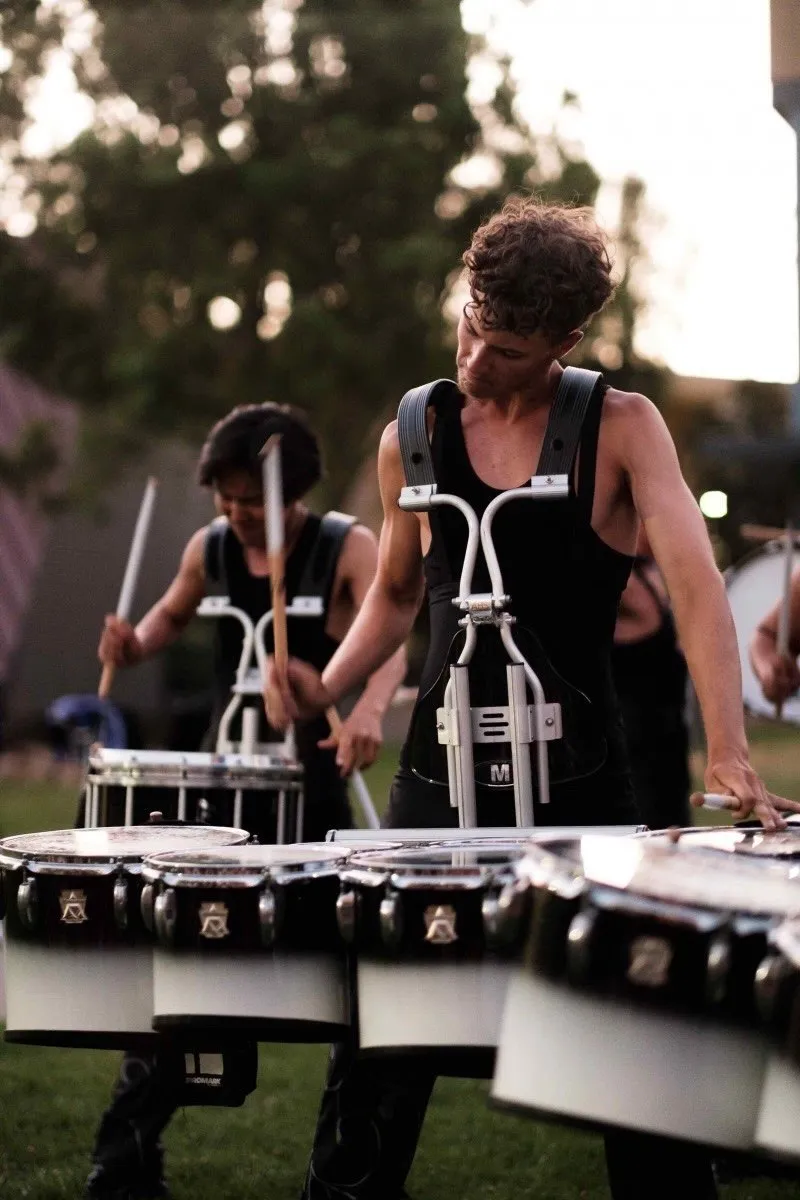
So what’s next? What are you excited about?
For me right now, the thing I’ve been looking forward to most has just been stasis. Being in the same spot. This has been my first summer in Boston ever, and it’s been so good to me. I’ve had my moments of post-age-out, post-college blues and stuff like that. But I haven’t been alone with myself in a room for a while. I think you know exactly what I mean, being on tour and stuff.
The band’s been going pretty well. I have a band called Sophie’s Body. It’s a rock band, all original music, and we’re really pushing ourselves. We got a really crazy gig coming up in September in Atlanta. It’s a really big festival, and we’re kind of opening for Twenty One Pilots. It’s technical, because it’s a huge festival and we’re at the bottom of a huge list. But you know, it counts. We’re really hoping it goes well, and I think it will. We’ve been doing a whole rollout, so we released three singles over the summer, and our debut album is coming out soon, which is really sick.
How did you meet the band?
Okay, so. First week or two of freshman year, I’m walking into a room because I thought there was a jam. Just to make some music with new people, meet somebody, be like, yo, what’s up. And I walk in on Sophie, who’s the lead singer, guitarist and songwriter, she’s the main person, and our drummer Dylan. And they’re rehearsing, playing some of the music. But I think it’s a jam, so I just walk in like, hey, what’s up guys?
And Sophie is immediately like, this is a closed rehearsal, you need to leave right now. And I’m like, oh, I’m sorry, oh God, I didn’t mean to, sorry. And I turn around, and they see the bass on my back. And they’re like, whoa whoa whoa whoa. Hang on. Where are you going?
So they let me plug in, we played some stuff, and they’re like, yeah, cool. Awesome. Thanks.
It wasn’t really a set thing at first. I joined because I was like, yeah, cool, that was a play. It wasn’t super intentful, it was kind of casual. But eventually we started spending enough time together that things got serious, because I think we all understood we had something to offer. Sophie’s original music, regardless of genre and what people might think of it, is undeniably really great original music. We all kind of subliminally understood that what we have is really cool and really worth taking a shot at. So we took it more seriously. We did a West Coast tour, a bunch of New England tours, we’ve hit the South, and we’re gonna hit the South again this October. From then on it’s just been making music with our friends and momentum, slowly building more and more stuff up.
We’re all Berklee grads, actually. It’s funny, sometimes that can have a negative connotation. Berklee is amazing, but there are definitely some stereotypes that can really outlast you. So I think sometimes we try not to mention it, because it gives a first impression.
How are you supporting yourself as a musician, especially with the move to New York?
There’s definitely other gigs I’m interested in, for sure. My dream scenario is Sophie’s Body goes triple platinum, we make it, we land it. And then also I’m getting called for other really cool high-profile gigs, if that makes sense.
Specifically, Tim Miller and that kind of music around New York is really big and a really cool scene. I think that’s what I’m looking for. Just being a touring musician, that’s my dream. And that’s another reason I’m sticking with it, because drum corps life is something I really fell in love with.
I’ve been surrounded by so many jazz musicians at Berklee. It’s pretty much a jazz school, so it’s kind of hard to, I don’t want to say avoid it, but all my best buddies have been jazz musicians, and I got into fusion and R&B and funk too. My senior year I auditioned for and made a really cool ensemble I got to be a leader in, the Prince Ensemble. It was a year-long directed study dedicated to Prince and his music and his legacy. Berklee has ensembles that are pretty low-key. This one was a huge production, like something you’d see tour around the world. So it’s music like that, where I get to express myself and play music I love with my friends outside the band.
One of my mentors at Berklee, Evan Marien, really inspired me to check out a lot of that music. He’s an incredible player, an incredible teacher, a really great role model for me. He’s played with Wayne Krantz. That’s the stuff I’m still so interested in, and that’s what New York is gonna be phenomenal for, if that makes sense.
Last one. What’s your advice for musicians coming up who want to go down a path like yours?
Trust your gut. There’s a gut feeling with a lot of this stuff, and realistically, if you don’t love what you’re doing there’s a good chance it won’t work out the way you want.
I feel like I’ve had a different bass story than I’ve had a quad story. With quads, I wasn’t concerned about success or status or where I’d march. All I cared about was when the next time I could get in my room and play on a practice pad was. That’s it. I loved the feeling of the sticks in my hand, learning a new lick, sharing it with people I love online. It was never for anything else. I just loved it and was obsessed with it.
Any aspiring musician should find what that is for them and chase it. No matter where it goes, you’re gonna be in love with it, and realistically, when that happens, any success or opportunities will gravitate toward you. I guarantee it, because that’s exactly what happened with quads. I just played and played and played, and then it almost felt like all of a sudden I was in the Blue Devils, if that makes sense.
That’s what I’m discovering with bass right now too. I’m getting over more and more hills because I’ve been able to spend more time with it, and I’m really finding what I love and what I’m obsessed with. That’s all you need. The rest will carry you there. I promise that for sure.